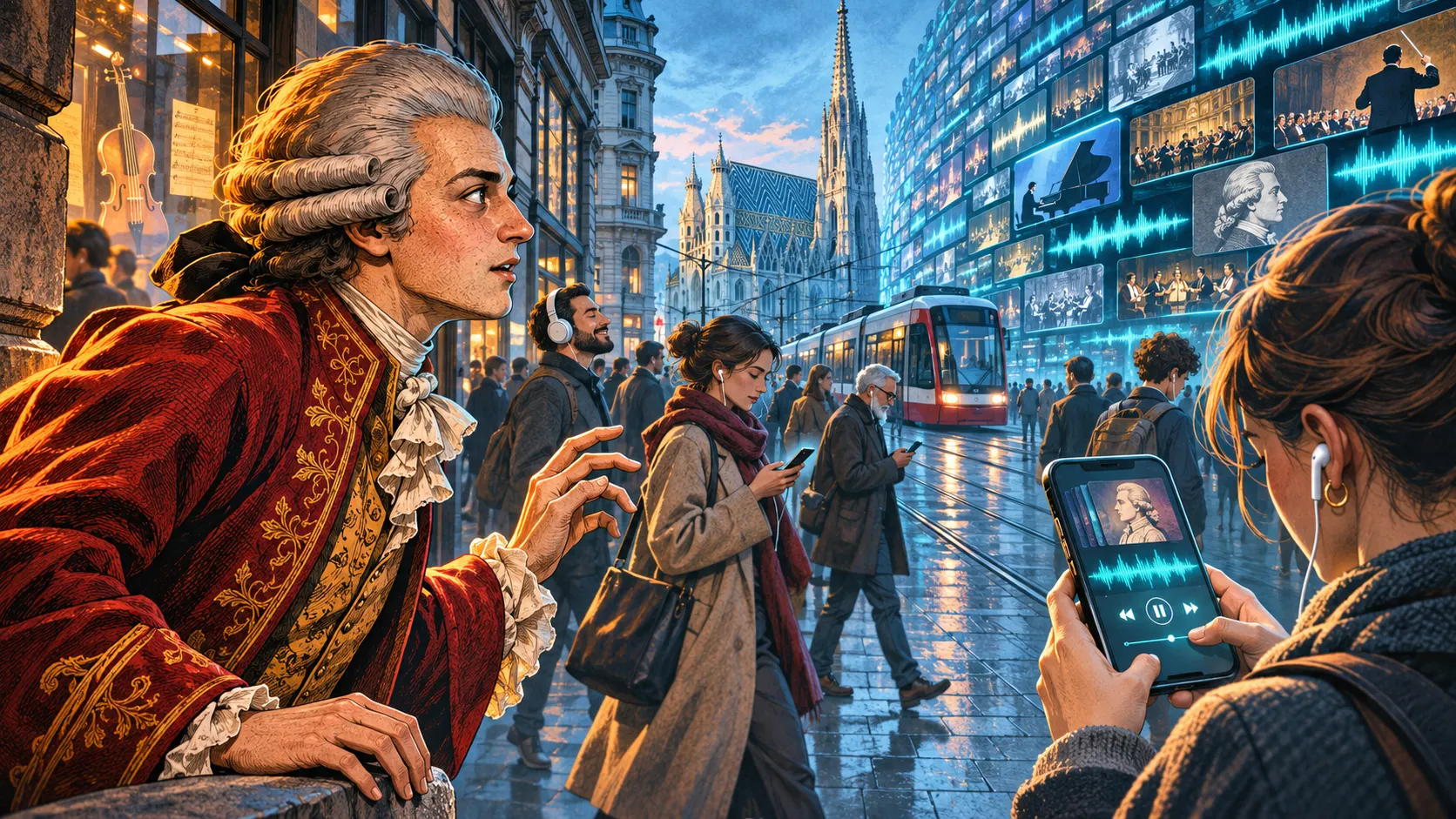
Mozart in a crimson coat leans out from a doorway on a modern Vienna street, watching commuters with earbuds and phones walk past a red tram and a wall of glowing screens, St. Stephen’s Cathedral behind them.

Now he wakes up on a street in modern Vienna.

Watch from 2:02

Mozart, 235 years later

Encounter 001, Wolfgang Amadeus Mozart (1756 to 1791)Left Vienna, 5 December 1791Arrives: a street in modern Vienna

What Mozart Would Think of Music Today

Would he back away from a synthesizer, or pull up a chair?

11:15. The player loads from YouTube only after you press play.

Moments across time

Six frames, each with the line heard over it.

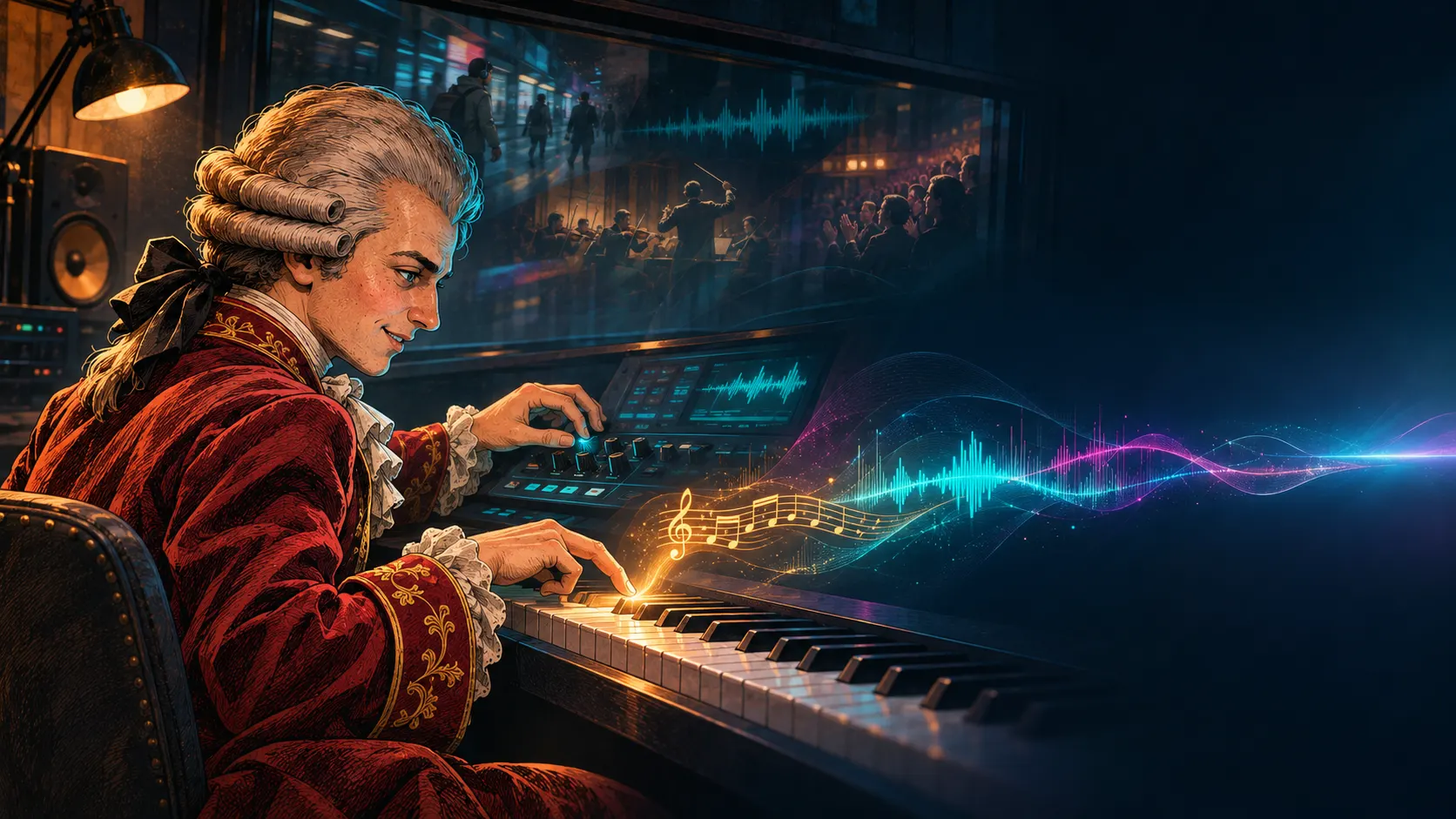
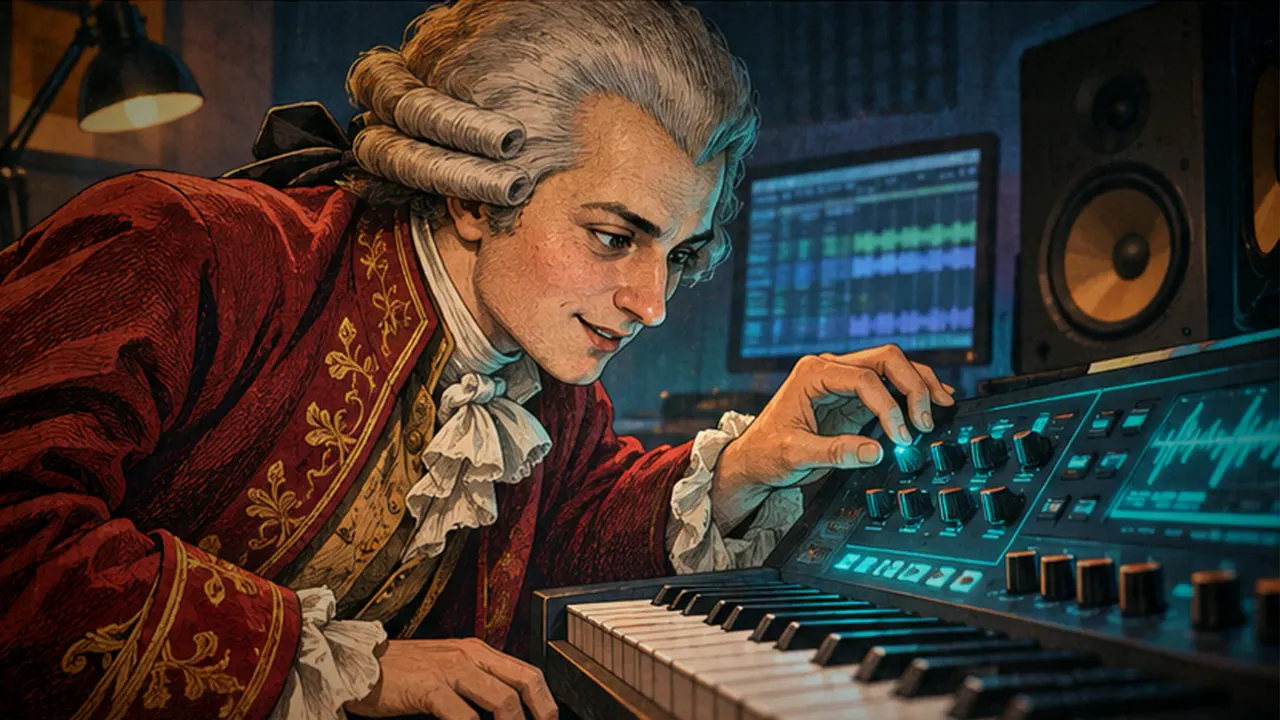
Mozart, lit warm, reaches for the glowing keys of a modern synthesizer in a recording studio.

Wolfgang Amadeus Mozart presses one key on a synthesizer.

One key, at 0:00

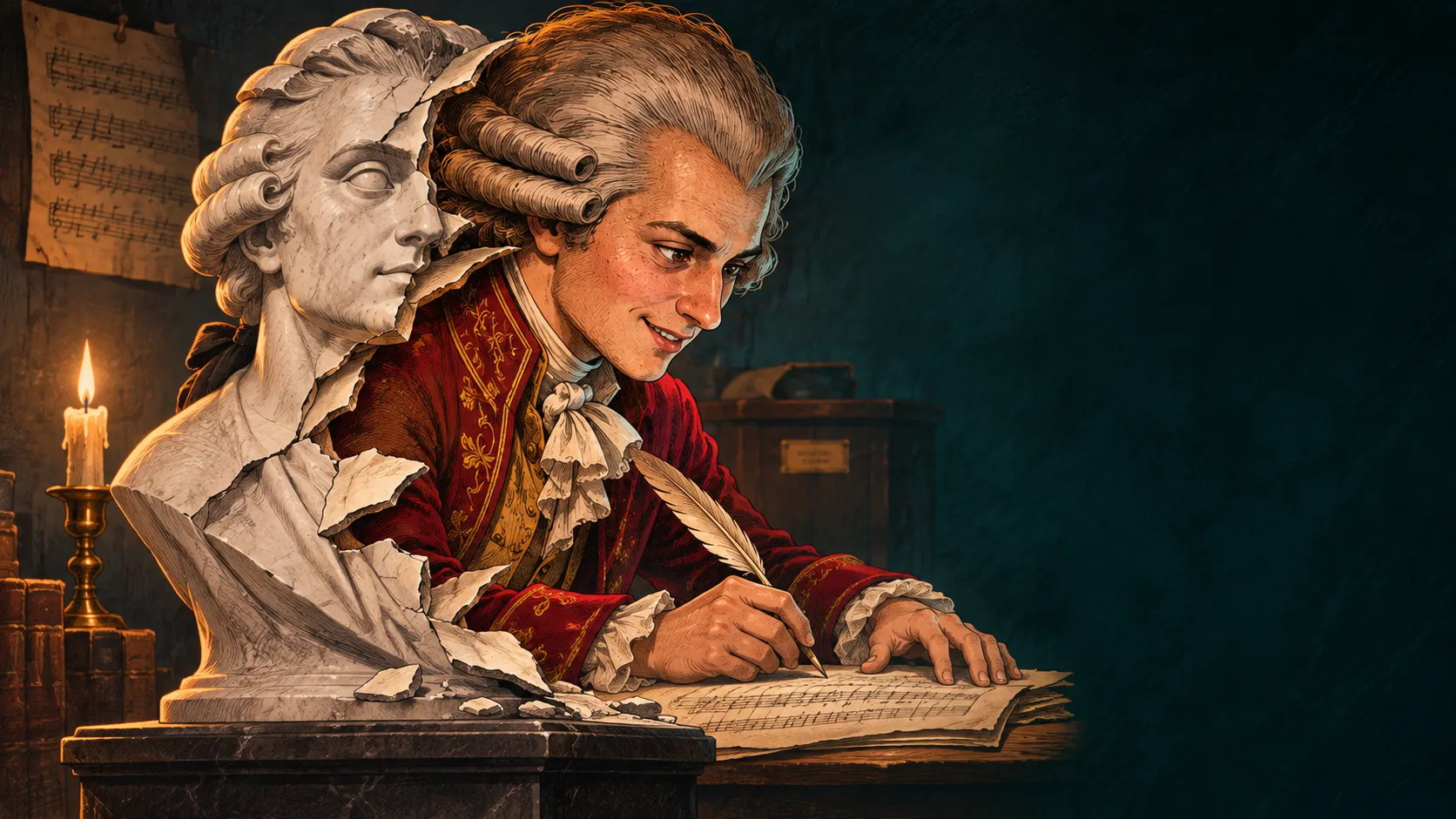
A cracked marble bust of Mozart beside the living Mozart, writing music by candlelight.

First, meet the man. Not the marble bust.

Meet the man, not the marble bust, at 0:58

Mozart in a crimson coat leans out from a doorway on a modern Vienna street, watching commuters with earbuds and phones walk past a red tram and a wall of glowing screens, St. Stephen’s Cathedral behind them.

Now he wakes up on a street in modern Vienna.

Waking up in modern Vienna, at 2:02

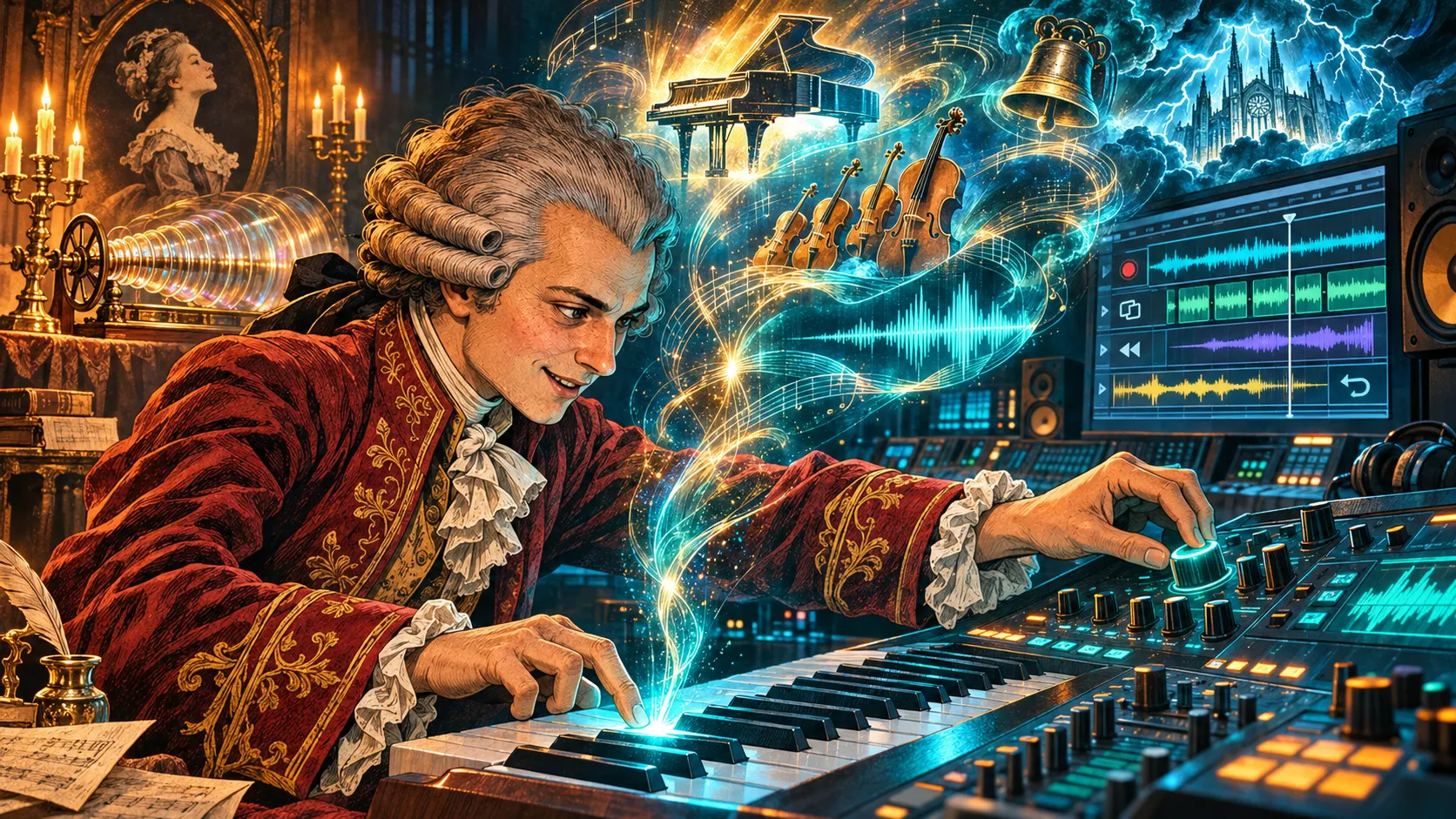
Mozart at a studio keyboard as a swirl of light becomes a piano, violins, a bell and a thunderstorm.

He asks what every button does.

The recording studio, at 4:24

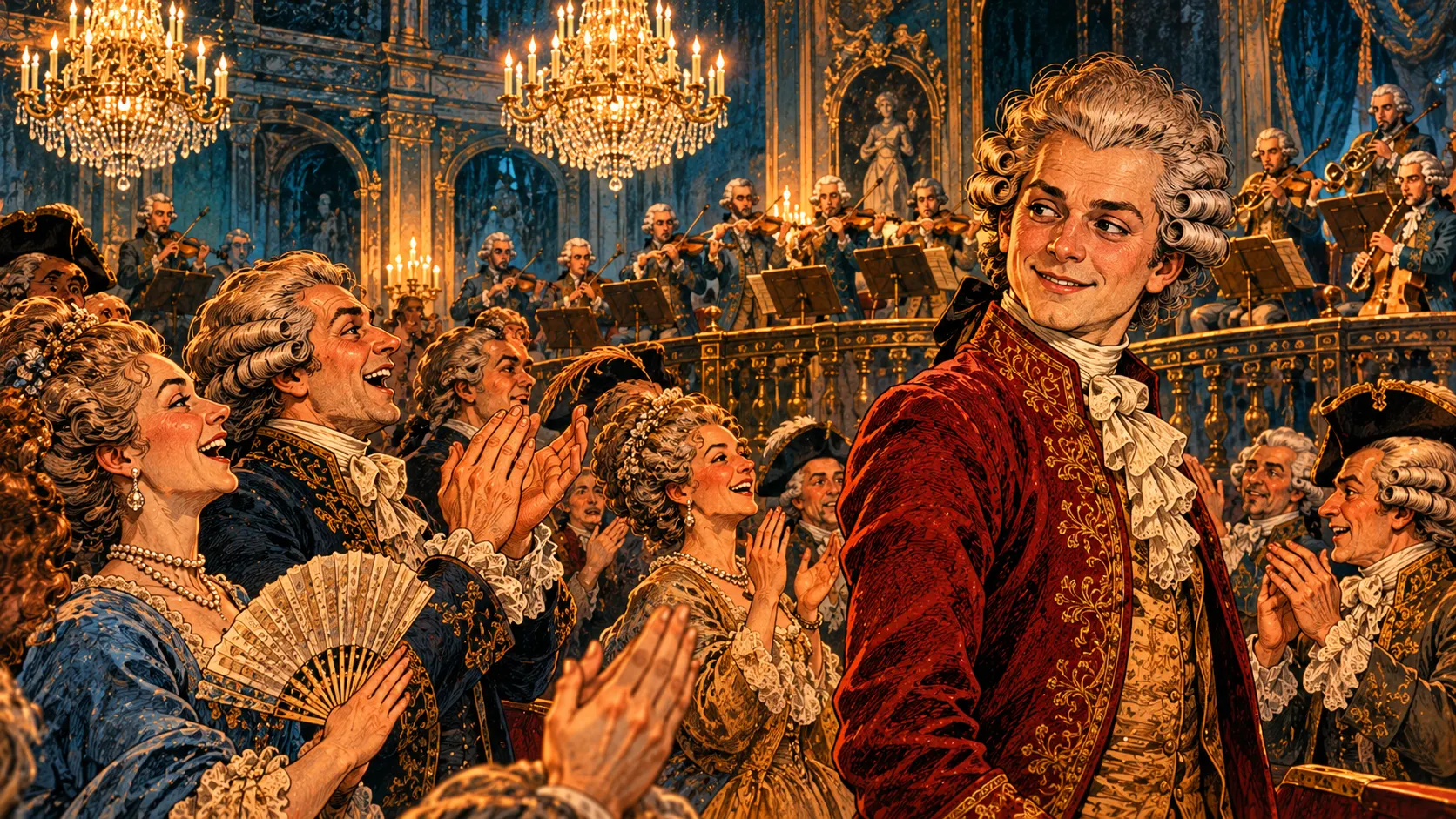
A Paris audience of 1778 bursts into applause mid-symphony while a young Mozart smiles at the side.

He engineered the applause.

Would he like the music?, at 6:08

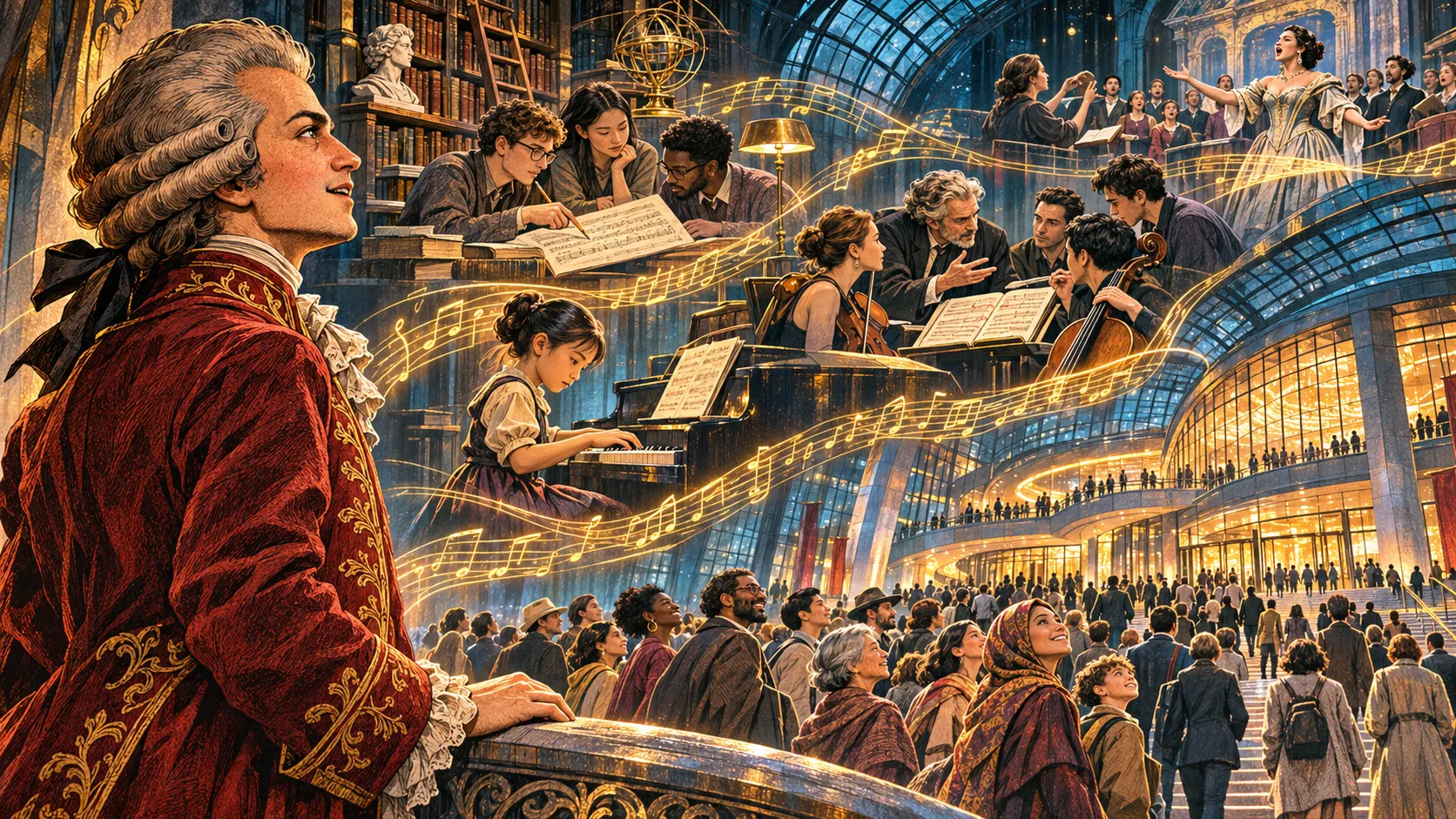
Mozart looks out over children at pianos, scholars, an opera stage and a crowd arriving at a concert hall.

More than two centuries later, they are still arriving.

The audience is still arriving, at 9:25

In Mozart’s own words

“In order to win applause, one must write stuff so inane that a coachman could sing it, or so unintelligible that it pleases precisely because no sensible man can understand it.”

“Ah, if only we had clarinets too!”

Myth or history?

Open a claim to see what the record says.

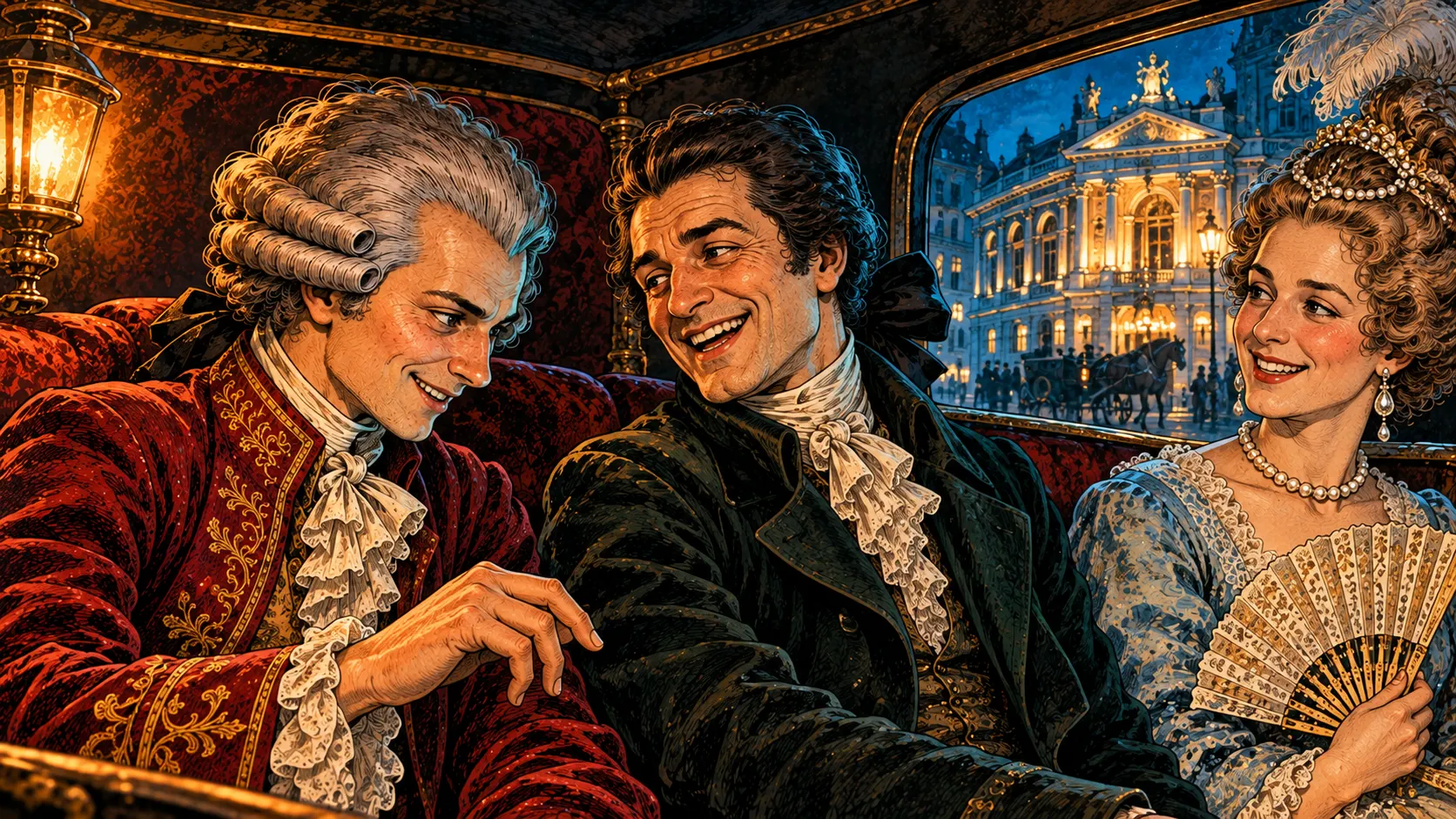
Mozart and Antonio Salieri laughing together in a lantern-lit carriage on the way to the theatre, a singer beside them.
Salieri hated Mozart, and may have poisoned him.Check the record

Myth.

They were rivals for jobs and commissions. They also wrote a short cantata together, Per la ricuperata salute di Ofelia (1785), which turned up in a Prague archive in 2015.

Seven weeks before he died, Mozart took Salieri to The Magic Flute and wrote to his wife that there was not a piece that didn’t draw a “Bravo!” or “Bello!” out of him.

Years later, Salieri taught Mozart’s son. The poison rumours began decades after Mozart’s death.

Sources: Mozart to Constanze, 14 October 1791, his last surviving letter; Per la ricuperata salute di Ofelia (1785, Salieri, Mozart and Cornetti), rediscovered at the Czech Museum of Music, Prague; announced 2016; Poison rumours arose in the 1820s; Pushkin’s play followed in 1830.

In the film at 7:43

Mozart was buried in a pauper’s grave.Check the record

Myth.

He received an ordinary third-class funeral, like most Viennese of his standing.

Sources: Death on 5 December 1791 at thirty-five; an ordinary third-class funeral.

In the film at 1:21

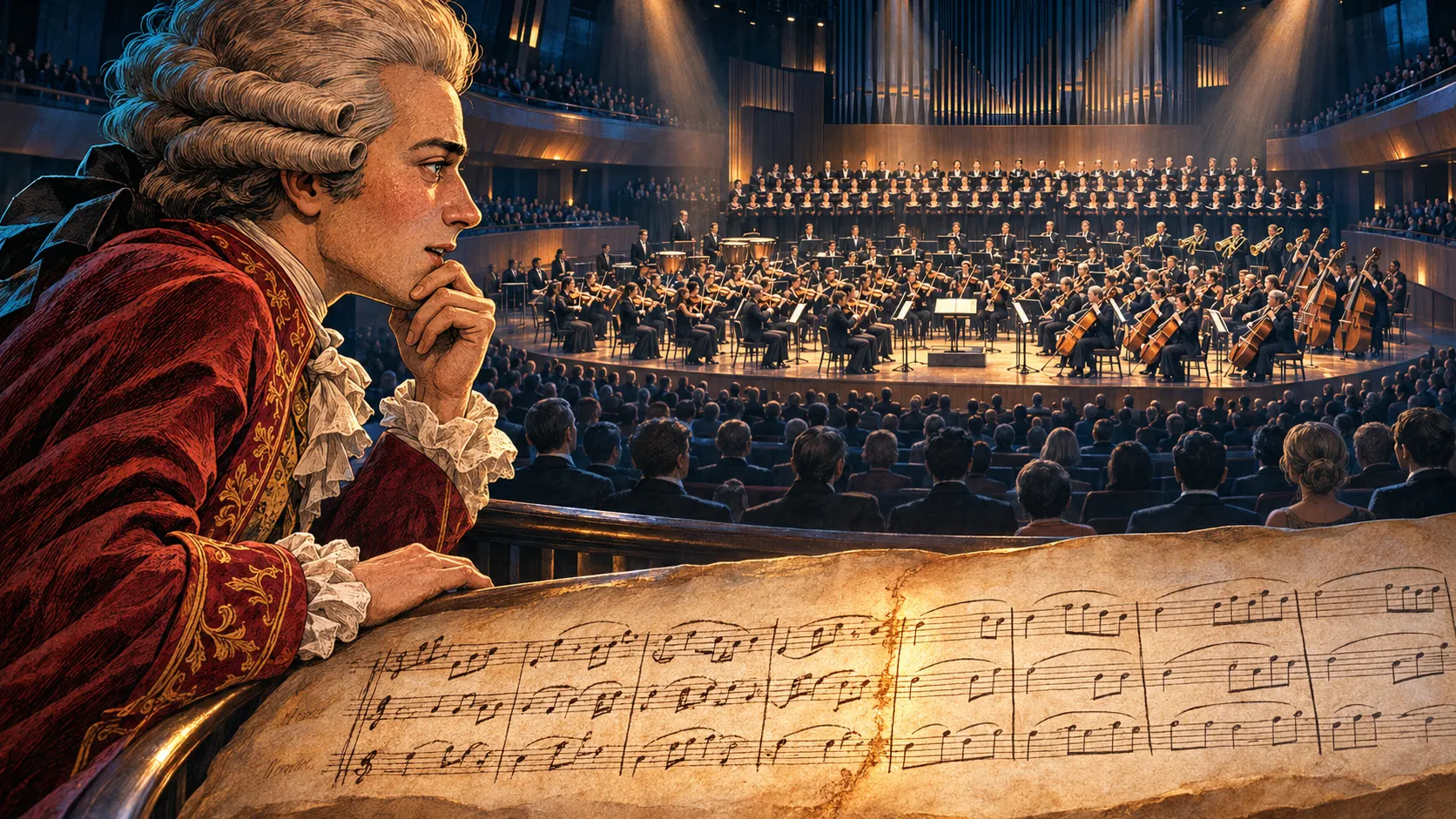
Mozart sits in a dark concert hall, chin on his hand, listening to an orchestra and choir, a page of his manuscript in the foreground.

Watch from 10:19

“Imagine sitting in the dark, listening to strangers finish the sentence you couldn’t.”

Behind the encounter

Everything Mozart does in this story is imagined. Everything he wrote, said, and composed is real.

Imagined for the film

  • Mozart waking up in modern Vienna
  • His reactions to earbuds, a recording studio, the undo button and the film Amadeus
  • Mozart in a concert hall hearing his Requiem completed by others

In Mozart’s words

4 documented quotations, spoken exactly as written.

On the record

All 10 sources behind the film
  • Letter. Mozart to his father, 28 December 1782 (the “coachman” letter)
  • Letter. Mozart to his father, Mannheim, 3 December 1778
  • Letter. Mozart to his father, Paris, 3 July 1778; translation corrected by Michael Lorenz, “Three Mistranslations of a Mozart Letter” (2014) michaelorenz.blogspot.com
  • Letter. Mozart to Constanze, 14 October 1791, his last surviving letter
  • Record. Per la ricuperata salute di Ofelia (1785, Salieri, Mozart and Cornetti), rediscovered at the Czech Museum of Music, Prague; announced 2016
  • Record. Poison rumours arose in the 1820s; Pushkin’s play followed in 1830
  • Record. Death on 5 December 1791 at thirty-five; an ordinary third-class funeral
  • Study. Rauscher, Shaw and Ky, “Music and spatial task performance”, Nature (1993)
  • Record. Don Giovanni, Act 2 dinner music: Una cosa rara, Fra i due litiganti, then “Non più andrai”
  • Manuscript. Mozart’s autograph of the Lacrimosa, bars 1 to 8; completed by Franz Xaver Süssmayr
Mozart, lit warm, reaches for the glowing keys of a modern synthesizer in a recording studio.

One afternoon with Mozart

From Vienna, 1791
to today

Admit oneTFM-001
Your ticket, number 001

A free keepsake from this encounter. Download it, print it, or send it to someone who would like the film.
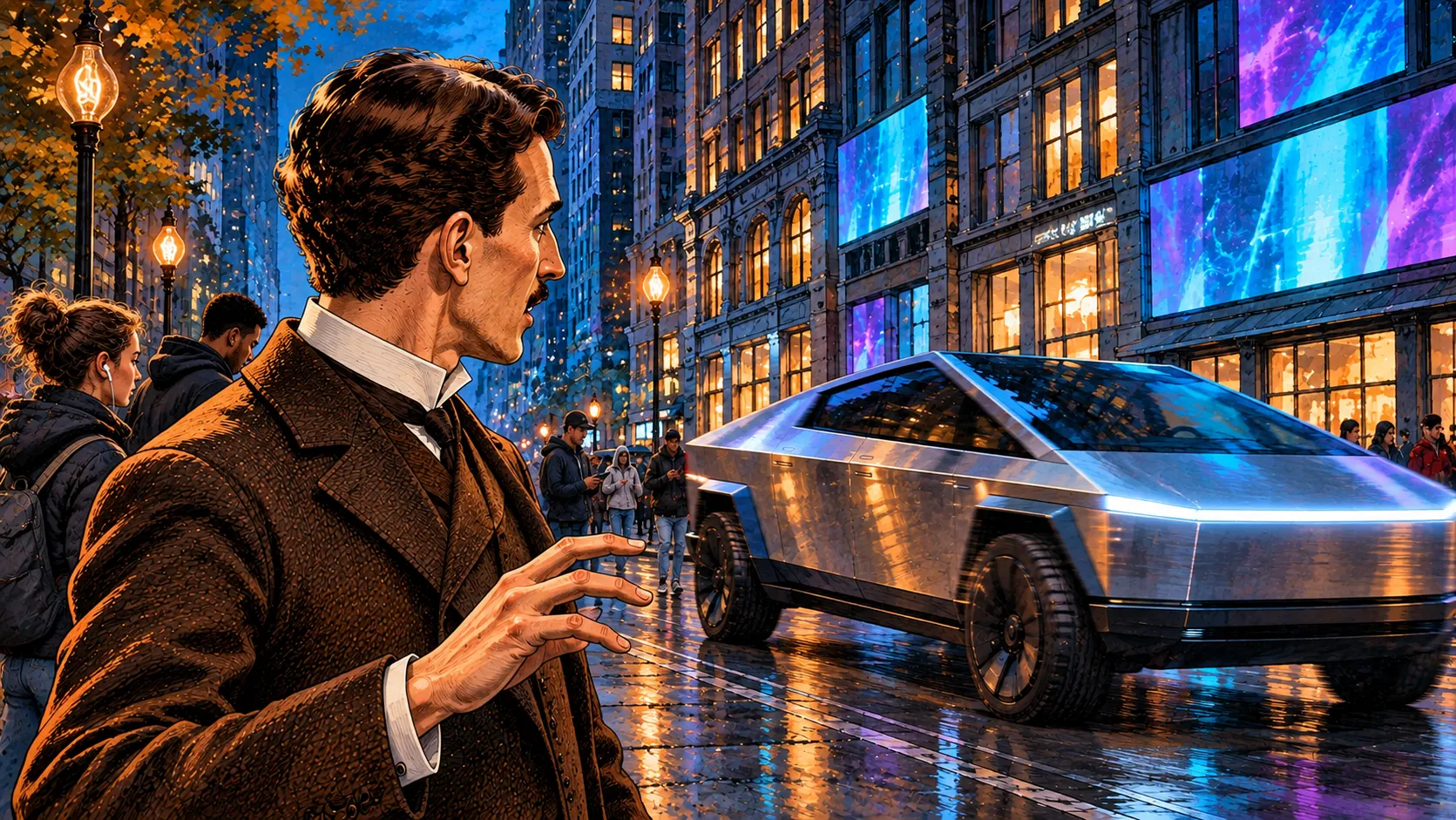
Nikola Tesla in a tweed jacket and high collar stands on a rain-wet Fifth Avenue at dusk, hand raised in astonishment as an angular stainless-steel truck glides past.

Continue with Nikola Tesla

What would he make of a phone in every hand, and a truck with his name on it?

Encounter 002